
« A lot of things come into perspective when you are around a lot of death. » – Kobai Scott Whitney
Working as a remote intensive care air ambulance paramedic out of Nome, Alaska, chronic staff shortages compounded in objectively dysfunctional management systems often led to stretches of days and nights of sleep-deprived runs to places most would be pressed to web search and Google map to find. Combined with the reality that there were no roads connecting Nome with the outside world—you were there, so you were on-call and working, and you just showed up when the pager went off. Amidst one such stretch, we were called to Shaktoolik, one of the many remote Native villages we served. Elderly female, CPR in-progress.
Calls to situations where CPR was being done were rare. It would be well over an hour before we could get to a village even in the best of weather conditions on the Bering and Chukchi Sea coasts and islands that made up our service area. It was literally not worth the response, as the outcome was not in question after such long a period of time.
We landed on the dirt airstrip outside the village and were driven, in an improvised trailer behind an ATV, in to the little clinic building. A small group of people were gathered outside. Inside, a few village health aides—village residents, women of varying ages who’d had some level of training and were able to manage many medical situations through telemedicine connections with the small hospital in Nome—were doing CPR. They were doing the best they could seeing that they’d been at it for over an hour, providing ventilations with a bag and mask connected to an oxygen tank between series of tiring chest compressions. A quick check—not breathing, no pulse, pupils fixed and dilated—and we instructed the health aides to resume CPR. We hooked up our cardiac monitor and checked the electrical activity of the heart. It showed flat line—no cardiac electrical activity. As the patient had an internal pacemaker, though, set to discharge in the event of a delay in or absence of any inherent electrical stimulus prompting the physical pumping of the heart, there were regularly-spaced, abrupt vertical lines moving across the screen—pacer spikes in medical jargon. The pacemaker was going off, but the heart was not responding.
We got an I.V. started and intubated the patient—guiding a cuffed tube between the vocal cords into the trachea by the light on the end of the curved blade of a laryngoscope. We pushed the I.V. medication called for in this situation with this cardiac activity rhythm—or in this case, lack of activity. Epinephrine, adrenaline in lay terms, would constrict the peripheral blood vessels, making CPR a bit more effective in circulating blood to the body core and the brain, keeping the brain viable for a while—the primary objective of CPR being delaying brain death before advanced life support (ALS) measures could be administered, not to bring a person back to life. We, as ALS providers, could, in some cases, restore some cardiac function. A brain deprived of oxygenated blood for any length of time, though, is another matter.
We continued CPR, rotating doing compressions among the two of us paramedics and the three health aides—hell, I’d once even had our pilot step in on chest compressions in a lengthy cold-water immersion call in Shishmaref, prompting some welcome debriefing on the flight back to Nome. My partner and I took turns ventilating. Every few minutes we’d stop compressions and check the monitor—no change—and push another round of epinephrine. We called the on-call M.D. back in Nome, gave a report, and sent a copy of the ECG, or electrocardiogram, strip that clearly showed flat line with the pacer spikes with no response from the heart. The M.D. told us to keep up the treatments for a little longer and call her back—likely to have her call it.
I’d been in many experiences like this back in northern Minnesota—working a cardiac arrest in some rural or remote area, far from a hospital, where our advanced life support would suffice, and suffice quite adequately I might add, for an emergency room. Many are familiar, from television and movies, with what a regular perfusing heart rhythm looks and sounds like (we often do, though, shut the sound off as that loud beeping noise tends to be a bit annoying in the back of an ambulance or confines of a KingAir 200 turboprop airplane). That regular heart rhythm, normal sinus rhythm—a little blip (the smaller atria chambers of the heart pumping blood into the larger, stronger ventricles below), a short pause, and then a big blip below and above the baseline (the ventricles pumping to the lungs and the entire body). And then there’s the bad one as seen and heard in those dramas—flat line, accompanied by the steady drone of an audible alarm.
In real life, though, there can be a number of rhythms between the former and the latter. That’s where we could have some influence. Flatline, though, asystole, no activity—there’s not much we, or anyone, can do. The defibrillators you see around airports and casinos, two of the more common places for sudden cardiac arrest, don’t start the heart as we may be led to believe. They actually stop a couple of the pulseless arhythmic activities of the heart—ventricular fibrillation being one (thus de-fibrillation). The heart’s self-supporting electrical generation and conduction, with something akin to a self-contained memory, can then restart on its own after a focused jolt of electricity stops the errant electrical activity. In the best of situations—with a relatively healthy person and quick basic life support CPR and then quick response by advanced life support providers—maybe four or five percent of patients experiencing sudden cardiac arrest will actually walk out of a hospital at some point. My record, if memory serves me, is three out of, oh, somewhere in the neighborhood of 100, maybe 120.
There in Shaktoolik, it was just us. I was used to that. But the monitor screen with that flatline with the incessant pacer spikes. We continued CPR and ventilation and epinephrine for over a half an hour, watching the screen for any signs that the heart was responding to the pacemaker activity. There were none. We couldn’t shut the pacemaker off. It would go for hours, if not a day or more, after we left.
I’d watched cardiac monitors many times while working in death experiences as a paramedic. I’d held the hands of people dying, watching their last breaths rise and fall. The actual instant of death, I had realized long ago in my paramedic, as well as my personal and pastoral care, experience—I could not put my finger on it. The starting and end points shown on the cardiac monitor provided book ends, just as we’d had in my parents decline in dementia between having our last meaningful, lucid conversations and being with them after their last breath had come and gone. But there was so much that falls between. One cannot put their finger on the instant death occurs, I would, and do, argue from more direct experience one probably should have.
There’s a metaphor in there—a metaphor, or allegory, that led me to Zen Buddhist practice myself. One cannot put one’s finger on it. It, the capital “I” It of the expansive, not confining, sense of emptiness and all it contains, including life and death, is free from such things as beginning and an end. As expressed in the Heart Sutra, here in its Upaya Zen Center rendition—
Boundlessness is free of old age and death
and free from the end of old age and death.
It is free of suffering, arising, cessation, and path,
and free of wisdom and attainment.
One cannot put one’s finger on the right now in just right here, right now, just this. Time flows, moves, and it arises in itself in the moment. Life, and death, flow and presents itself in the moment.
“We cannot distinguish where the waterfall starts and ends because it is a continuous process,” writes Zen teacher Shohaku Okumura. “We see things happening every moment, but yet we cannot grasp them.”
Amidst and against my experiences with death, Zen just made sense to me, and I could not put my finger on it. Now, after years of study and practice and life experience, it still makes sense to me. And I cannot put my finger on it.
We called in to the M.D. in Nome and gave an update. No change. We all agreed to call it and advised the health aids to stop CPR. They composed themselves and asked us if they could sing for the patient, someone they’d known all their lives. “Of course,” we answered.
I stepped back, looking forward to hearing a Yupik death song or a Christian hymn sung in their Native tongue—something heard frequently from the Covenant Church’s AM radio station out of Nome broadcast at the strongest signal they could possibly operate with to make sure they didn’t miss a single unsaved soul along the Alaska coast, over the islands, and catching as many as they could on the Chukchi Peninisula, Siberia, Russia, visible from some of the villages we flew to and sharing some of the 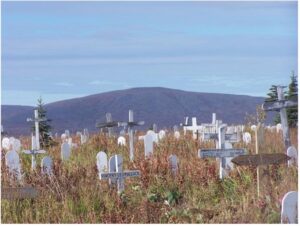 same Native languages found on the U.S. side. I confess that I was disappointed when they broke out with “Shall we gather at the river, the beautiful, beautiful river,” albeit fittingly out of tune and with a hint of a Native song rhythm. We disconnected the intubation tube and cardiac monitor—the same pacer spike-broken flatline running across the screen before we shut it off.
There were no funeral homes in Nome—nor car washes or insurance agencies for that matter. The dead are buried in shallow graves in the permafrost-limiting ground, usually with a simple wooden marker as shipping cost renders granite or other stone beyond the reach for most. Practicality and function rightfully rule in places like Alaska’s Seward Peninsula. In places like Shaktoolik, the graves are often minimal and found along the same marginal road or trail which we passed on to and from the airstrip and clinic. Some graves are just covered with rocks to offer the most basic protection, as it was not uncommon to see ravens and foxes scavenging through some arctic village cemeteries.
After we left Shaktoolik, after the health aides finished their appropriated Pentecostal hymn, we got back to Nome and cleaned up. That night, I woke from a well-deserved deep sleep in a sweat in a dream, a nightmare, in which I had envisioned the woman in Shaktoolik waking up under the rocks making up her grave.
References:
- Okumura, Shohaku. 2012. Living by Vow: A practical introduction to eight essential Zen chants and texts. Somerville, MA: Wisdom Publications.
- Upaya Zen Center. 2024. Gathas and Chants. In Jukai Book. Santa Fe, NM: Upaya Zen Center.
Photos:
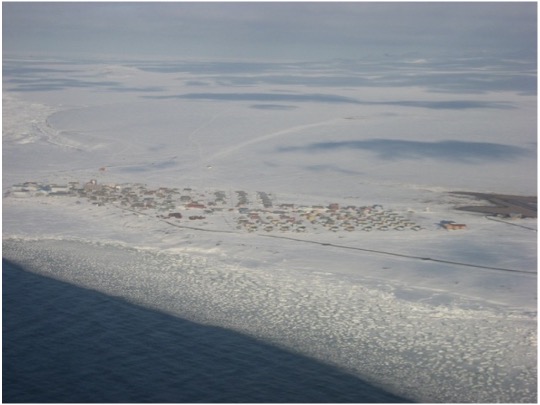
- Approach to Savoonga, St. Lawrence Island, Alaska
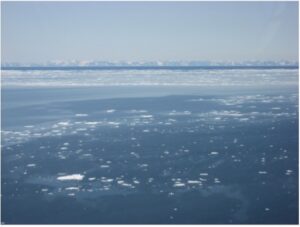
- Chukchi Peninsula (Chukotskiy Poluostrov), Siberia, Russia—from approach to Gambell, St. Lawrence Island, Alaska
- Nome, Alaska Cemetery
(Note: Photo credit—I believe they’re mine. With a rather extensive digital file of photo images from my time in Alaska taken by me and/or shared among cohorts during that time, I can’t be entirely sure on source on some. No matter, though. I’m sure those cohorts likely don’t remember, too—and if they did, would not mind if they were shared.)
Bio:
Peter Pierson has made home from northern Minnesota to Saskatchewan; Nome and Fairbanks, Alaska; and Prescott, Arizona. A one-time Minnesota Arts Council/McKnight Fellowship recipient for his memoir and nonfiction work, his writing has been published in, among others, Natural History Institute’s Real Ground, Minnesota Monthly, Voices for the Land (Minnesota State Historical Society Press), the The Ester (Alaska) Republic, and in the various Zen Peacemakers International offerings. His radio essay work has been produced and broadcast for KAXE/KBXE-Northern (Minnesota) Community Radio and CBC Radio One in Canada.
A past participant in the Native American Bearing Witness program, Peter started his Zen practice and study with Dharma Field in Minneapolis and is currently finishing his chaplaincy training with Upaya Zen Center. He now resides in the greater Kansas City community and offers his time and attention in chaplaincy in the Kansas State Correctional Facility-Lansing long-term and hospice care arenas.